
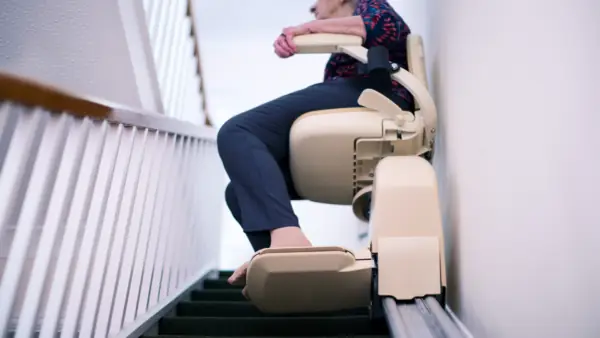
Straight vs curved stair lifts serve different staircase layouts. Choosing between them starts with one question: does your staircase travel in a single straight line, or does it turn, curve, or cross a landing? The answer usually determines the type of rail your home needs. This guide explains the differences, what affects the final price, and how to choose a safe, practical solution without paying for features you do not need.
Quick answer: A straight stair lift is usually the simplest and most affordable choice for one uninterrupted flight of stairs. A curved stair lift uses a custom-made rail for stairs with turns, intermediate landings, or changing angles.
What Is a Straight Stair Lift?
A straight stair lift travels on a rail installed along a staircase that does not turn. The rail is manufactured in standard sections and cut to fit the length of the stairs. Because the design is standardized, straight lifts are generally faster to prepare, easier to install, and less expensive than curved systems.
A straight lift may be the right choice when your staircase:
- Runs from one floor to another without a turn
- Has no intermediate landing that the lift must cross
- Maintains a consistent angle from the first step to the last
- Has enough width for the user, chair, and footrest
Straight models are available as new units and as carefully inspected, S.E.I. Certified reconditioned stair lifts. A reconditioned unit can be a practical way to reduce cost when the staircase and the available rail are a good match.
What Is a Curved Stair Lift?
A curved stair lift follows a rail built specifically for the shape of a particular staircase. It can travel around corners, across landings, and through changes in pitch. The rail may also extend beyond the top or bottom step to create a safer place to get on or off the chair.
A curved system is usually required when the staircase:
- Turns left or right
- Includes a pie-shaped or spiral section
- Has one or more intermediate landings
- Changes angle between sections
- Needs one continuous ride across multiple flights
Curved lifts require precise measurements and more planning because the rail must fit the staircase closely. Learn more about Star Lift's custom curved stair lift installation process.
Straight vs. Curved Stair Lifts at a Glance
| Factor | Straight Stair Lift | Curved Stair Lift |
|---|---|---|
| Staircase shape | One straight, uninterrupted flight | Turns, curves, landings, or changing angles |
| Rail | Standard rail cut to length | Custom rail built for the staircase |
| Typical cost | Lower | Higher due to custom design and fabrication |
| Lead time | Usually shorter | Usually longer because the rail is custom-made |
| Installation | Often completed relatively quickly after the correct unit is available | Requires detailed measurement, fabrication, and a more involved installation |
| Future reuse | More adaptable to another compatible straight staircase | Rail is built for one staircase and is less transferable |
What Affects the Cost?
The rail design is the biggest difference, but it is not the only factor. The final price may also depend on the stair length, number of turns, selected chair, power options, rail extensions, folding features, installation conditions, and whether a suitable reconditioned unit is available.
When comparing quotes, make sure each company is pricing the same scope. Ask whether the estimate includes professional installation, warranty coverage, delivery, removal of an existing lift, and any electrical work that may be required. A low starting price is not useful if necessary items are added later.
Can Two Straight Lifts Replace One Curved Lift?
Sometimes two straight lifts can be installed on separate flights with a landing between them. This approach may cost less than one custom curved lift, but it requires the user to transfer from one chair to another on the landing.
That transfer is not appropriate for every person. Consider balance, strength, walker placement, landing size, and whether the user can stand and turn safely. If a continuous ride is needed, a curved lift is usually the better choice even when it costs more.
Important Safety and Fit Considerations
A stair lift should be selected for both the staircase and the person using it. A professional evaluation should consider:
- Stair width: There must be adequate clearance for the user's knees and for others who still use the stairs.
- Entry and exit: The chair should stop where the user can sit down and stand up securely.
- Weight capacity: The selected model must meet the user's needs without exceeding the manufacturer's rating.
- Seat orientation: Swivel seating can help the user exit away from the open staircase.
- Obstructions: Doors, trim, handrails, radiators, and nearby walkways can affect rail placement.
- Parking and charging: Battery-powered lifts need reliable charging locations at their designated stopping points.
Stair lift rails are generally secured to the stair treads, not the wall. This makes installation possible in many homes without major structural remodeling. The exact mounting method depends on the equipment and staircase.
New or Reconditioned?
Both new and professionally reconditioned stair lifts can be good options. The better choice depends on budget, required features, staircase configuration, availability, and warranty terms. Straight lifts are typically easier to recondition and match to another staircase because the rail is not custom-shaped. Curved systems require a rail that fits the specific stairs, although certain components may still be reusable when properly evaluated.
Do not judge a used lift by appearance alone. Ask what was inspected, what was replaced, how the unit was tested, and what warranty is included. Star Lift's certification process documents a 27-point inspection performed through an independent third party.
Which Stair Lift Is Right for Your Home?
Choose a straight stair lift when the stairs run in one line and the user can safely enter and exit at both ends. Choose a curved stair lift when the rail must turn, cross a landing, change angle, or provide one continuous ride across multiple flights.
The best way to confirm the fit is an in-home assessment. Accurate measurements can identify clearance problems, landing hazards, and cost-saving alternatives before equipment is ordered. Star Lift can also explain new and reconditioned options without pushing you toward a more complex system than your home requires.
Frequently Asked Questions
How do I know if I need a curved stair lift?
If the lift must travel around a corner, across a landing, or through a change in stair angle, it generally needs a custom curved rail. A staircase evaluation can confirm whether two straight lifts are a safe alternative.
Why does a curved stair lift cost more?
The rail is measured, designed, and fabricated for a specific staircase. That custom work requires more time and material than cutting a standard straight rail to length.
How long does stair lift installation take?
Installation time depends on the staircase, equipment, and site conditions. Straight lifts are usually quicker to prepare and install. Curved lifts require custom fabrication before installation can be scheduled.
Will a stair lift damage my wall?
Stair lift rails are typically mounted to the stair treads rather than the wall. Minor mounting holes remain when the lift is removed, but extensive wall construction is usually unnecessary.
Do stair lifts work during a power outage?
Many modern stair lifts operate on rechargeable batteries and can continue running for a limited number of trips during an outage, provided the batteries are charged and in good condition. Follow the manufacturer's instructions and schedule professional stair lift service if the lift is not charging correctly.
Get a Straightforward Recommendation
Star Lift LLC installs straight and curved stair lifts, including new and S.E.I. Certified reconditioned options. Contact Star Lift or call (888) 778-2475 to schedule a consultation and find the right fit for your home.